



 OEM & ODM Service
 Development Service
 Download
 Technical support
 Warranty & RMA
 FAQS
FAQS
 My Community
 Who Is CIVINTEC
 Why CIVINTEC
 News & Express
 Cooperation




Campus & Education Smart Access Control Solution – Ensuring Safety, Efficiency, and Trust in Every Entry.
Get Quote
Overview
A truly effective learning environment is built upon a foundation of safety and trust. As campuses welcome an ever-shifting population of students, faculty, and visitors, the challenge of managing access for a diverse community whose needs change by the hour—from lecture halls and libraries to dormitories and research centers. Traditional security measures often fall short in addressing the unique fluidity and scale of academic life.
This is where intelligent access control becomes indispensable. Moving beyond simple credentials, a modern system functions as an intelligent gatekeeper, evaluating each access request in real-time based on who, where, and when. It understands the context of each access attempt—authorizing the right individuals for the right spaces at the right times. This proactive approach is key to streamlining campus operations while creating a secure, unobtrusive, and focused atmosphere where education can thrive.
The traditional physical key is easy to be cloned or theft and hard to management. CIVINTEC access control system supports multi technologies authentication for role-based access control to manage the access rights of students, faculty, staff, and visitors.

Use smartphone as mobile credential encrypted by AES via BLE or NFC

For visitor temporary access with time limit for short-term guests or cleaners etc.

125KHz, 13.56MHz Mifare® and DESFire® EV2/EV3 with SAM AV2/AV3 smart cards

Fingerprint or facial recoginition


CIVINTEC enables cloud-based remote management, allowing door access control and real-time entry monitoring from anywhere to ensure efficient, centralized supervision across zones.

Ethernet(PoE), Wi-Fi, LoRaWAN, 4G LTE (with GPS)

Server remotely authenticates credentials, verifies permissions, and authorizes door unlock, ensuring secure centralized control and accurate access logging.

Under offline, access terminal verifies identities, grants access, and stores all events locally with thousands of encrypted user credentials.

CIVINTEC access control ensures access control and data security through advanced encryption protection for all data transmissions and credentials.

AES Encrypted RFID DESFire smart card and mobile credentials with SAM MIFARE AV2/AV3 secures keys at EAL5+/EAL6+

CIVINTEC devices support encrypted protocols: OSDP, HTTPS TLS 1.3 with enhanced CA certificate verification.

Access Security requires a proactive system that monitors the health and integrity of every access point in real-time.

CIVINTEC transforms access events into actionable data: track entry, flag denials/expired credentials, detects forced entries/tailgating, monitors doors, triggers tamper alarms, and provides real-time alerts with logs for enhanced security.

CIVINTEC terminals integrate with fire alarms to automatically unlock exits and secure hazards, ensuring safe evacuation during emergencies.


Managing the access rights of thousands of students, faculty, staff, and visitors across dozens of buildings or multiple campuses is a monumental logistical task. A centralized platform eliminates the inefficiency and vulnerability of physical keys or disparate card systems.
· Managers can real-time track access logs and personal activities for remote control multi- room/building on campus. Access control reader can be authorized according to different roles, allowing only authorized personnel to access specific areas. For example, campus gate, dormitory, classroom, dining, computer room, library, parking lot, sport court, supermarket, etc.
· Campus system must remain functional under all conditions. CIVINTEC' s architecture ensures that your security remains "Always-On," even during network failures. In a sprawling campus environment, a network outage or server downtime shouldn't mean a total security collapse. CIVINTEC implements secure access control Local Mode that guarantees 100% operational continuity.

· Visitors & Contractors: Temporary access (e.g., contractors, suppliers, assistants) uses dynamic QR codes via mobile phones. Administrators issue time-limited codes that expire after a timeout. Unlike static codes, these cannot be screenshotted or shared, ensuring only authorized guests enter.
· Students: Mobile access via encrypted BLE or NFC by using personal smart phone — eliminating the security risk and cost of lost physical cards.
· High-Security Areas : Advanced secure access by multi-factor authentication combining biometrics with Mifare DESFire EV3 smart cards and password for research laboratories and data centers.
· Car Parking: Visitors select a BLE mobile ID and send it to a CIVINTEC reader. This opens the parking gate from up to 5 meters away before the visitor arrives, providing convenient, contactless access.

Modern access control systems enable the creation of finely-tuned security zones. This goes beyond basic perimeter control to protect multiple campuses or sensitive areas like research laboratories, residence halls after hours, administrative offices, and health centers. By ensuring only pre-authorized individuals can enter specific spaces at designated times.
· High security for critical zone
When it comes to securing sensitive areas, or anywhere you require high security. What's important is keeping the access control logic safely. High-security access control provide Anti-Passback APB to protect both sides of an access point. It can be intelligently configured into a slave mode for entrances, while operating seamlessly with room interior relay-enabled card readers for exits.
· Toggle function for public zone
CIVINTEC' s TOGGLE function delivers centralized command over door states. Administrators can instantly switch any door or an entire zone between Secure, Open, and Locked modes, either on-demand or per a schedule. This provides strategic flexibility for daily operations, emergencies, and unified security response.

Manual roll calls are slow and prone to errors or proxy attendance. CIVINTEC' s high-precision readers at classroom entrances turn attendance into a seamless, data-driven process.
· Real-Time Presence Verification: Students simply "tap-and-go" using their RFID cards or mobile BLE credentials. The system captures attendance data in milliseconds, allowing professors to maximize instructional time.
· System Integration : CIVINTEC access control terminal acts as a data bridge, feeding real-time attendance logs directly into the university student information systems. This automation allows for the immediate identification of absenteeism patterns, enabling early intervention by academic advisors.
· Faculty & Staff Payroll Optimization : Beyond students, the access control terminal tracks the real working hours of faculty and administrative staff, enabling accurate payroll processing.

The modern "Smart Campus" aims to reduce the friction of daily life by eliminating the need for physical cash. CIVINTEC' s advanced encrypted RFID and NFC readers serve as the critical hardware interface for a comprehensive cashless ecosystem, turning a simple security ID into a powerful multi-functional tool.
· The Unified Digital Wallet : To improve the dining needs of students and faculty members, eliminate queues and save valuable time, access control reader allows faculty members and students to use their secure credentials for non-cash payments across all facilities — from the main cafeteria and canteens to campus bookstores and laundry rooms. More campus buildings are becoming smarter, and more college and university environments are becoming safer, secure, and convenient.
· Enhanced Financial Insights: For the university, every transaction provides valuable data on consumption trends. This allows for better inventory management in canteens and bookstores, ensuring that resources are allocated based on actual student demand.

In an unattended gym, there is no front-desk staff to explain why a card was rejected or how to scan a phone. Therefore, the terminal must be entirely self-explanatory to prevent member frustration and support tickets.
· High-Resolution Visual Feedback
Look for terminals equipped with vivid, high-resolution touchscreens. The CIVINTEC access control system with 3.5" or 7" touch screen, for example, provides clear visual guidance through customizable icons, image and text.
· Real-Time Member Communication
The interface should do more than just show a green light. It should communicate specific status updates, such as "Welcome Back, Sarah," "Access Denied: Membership Expired," or "Reminder: Safety Induction Required."
· Customizable Touch-Keys
For facilities offering guest access or emergency assistance, the ability to have on-screen "virtual buttons" allows members to trigger specific actions, such as requesting a callback or opening a temporary locker, directly from the terminal.
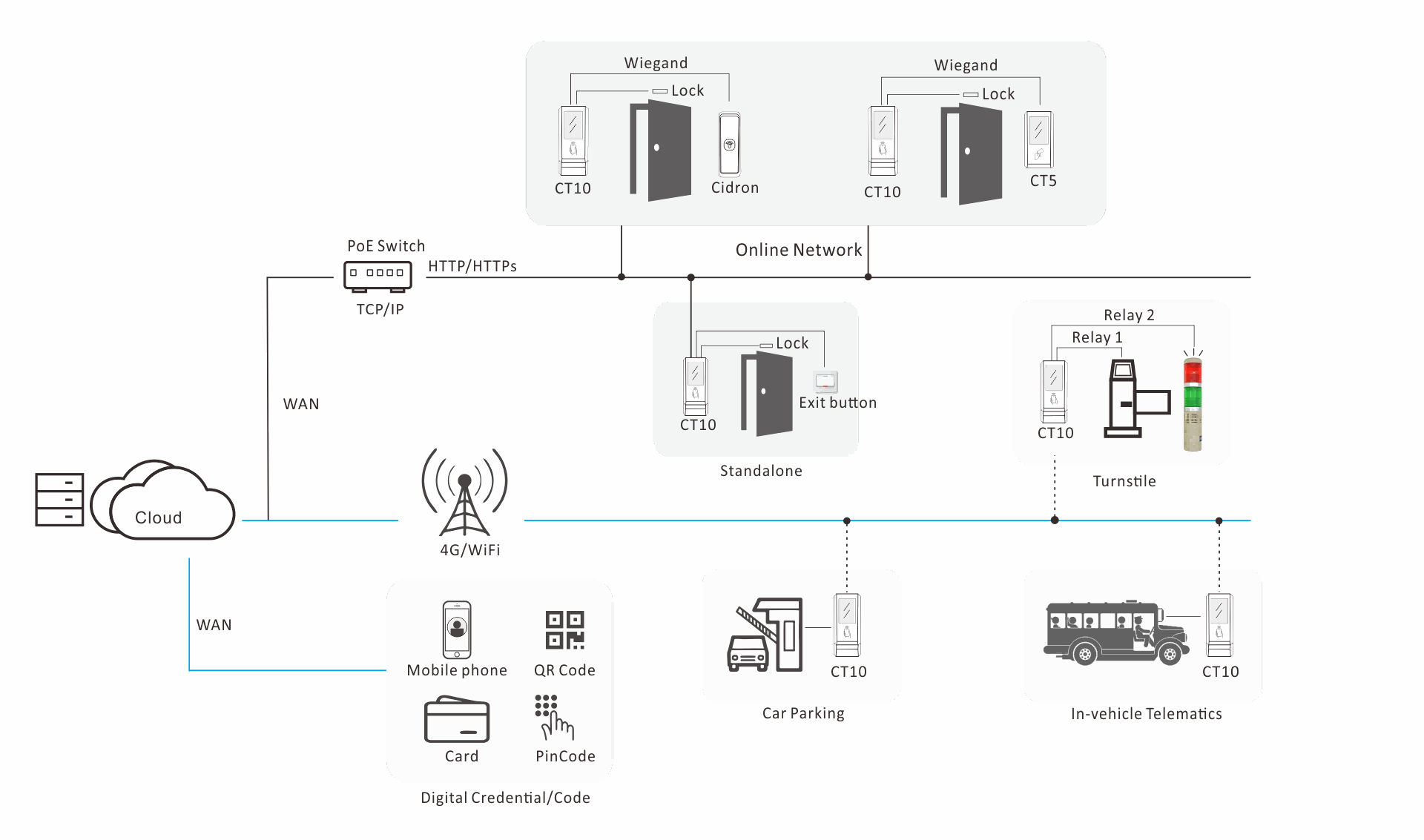
CIVINTEC access control terminal is designed with versatile GPI/O port and interfaces to build comprehensive security and IoT access control solutions features of less wiring and cost-save installation.
Centralized Network Management
CIVINTEC wire and wireless HTTP/HTTPs networked access control terminals that operate over WiFi, LoRaWAN, 4G LTE (GPS) and Ethernet (Power Over Ethernet) for less wiring and cost-save installation, connecvity to manage both online and local mode access control applicaons. This ensures seamless operation in any environments, even those with limited or no local network access.
High-Security Access Soluon Tailored for Crical Areas
CIVINTEC access control system supports APB (anti-passing back) external door reader via wiegand/RS485 interface to protect both sides of an access point. It can be intelligently configured into a slave mode for entrances, while operating seamlessly with room interior relay-enabled card readers for exits.
Intelligent Access and Facility Control
CIVINTEC access control terminal with rich I/O ports to seamlessly work with external devices enabling door lock control, door contact monitoring, exit button, and fire alarm. Equipped with multiple relay outputs, CIVINTEC smart IoT & access control system is ideal for centralized remote management of electric locks, lighting, and other facilities from a central server in real time.


 Share
Share
 Home >


 Contact Us